
Given today is National Girls and Women in Sports Day AND the fact that the 2026 Milano-Cortina Olympic & Paralympic Games officially begin on Friday, we wanted to share a bit about three of our amazing Next League team members who all happen to be Team USA athletes!
Learn more about Veronica Day, Rachel Rane and Macy Tarlton below.
VERONICA DAY


I am a former member of the U.S. National Skeleton Team, where I competed for Team USA for nine years. During my career, I was fortunate to earn multiple accolades, including National Push Champion, National Start Record Holder, North American Cup Overall Champion, and the Randy Price Sportsmanship Award. I served as the Athlete Advisory Council representative and spent four years as a member of the USA Bobsled & Skeleton Board of Directors. Throughout my career, I lived and trained at two U.S. Olympic & Paralympic Training Centers, Lake Placid, New York and Colorado Springs, Colorado.
I discovered skeleton after watching the sport at the 2010 Vancouver Olympic Games, noting that many athletes shared my track and field background. At that time, I competed for Elon University as a long and triple jumper. At Elon, I was a 5-time school record holder, a 3-time conference champion, named the Southern Conference's MVP, NCAA qualifier, and was later inducted into the university’s Athletic Hall of Fame.
Since retiring from competitive sport, I worked in athlete services at the U.S. Olympic & Paralympic Committee before transitioning into operations/sports technology at Next League for the last 3 years.
Given my background, I also volunteer in local student mentoring programs supporting athlete development. Additionally, I previously led the creation of Crossover for Change, a nonprofit organization that built sports facilities in Uganda, resulting in three completed facilities and expanded access to sport for more than 10,000 girls.
I currently reside in Telluride, Colorado, where I spend my weekends skiing - my enthusiasm for it far outpaces talent 🙂
RACHEL RANE


I started coxing my freshman year of high school and was later recruited to the University of Texas, where I coxed the Varsity 8+ for three competitive seasons and won back-to-back NCAA team championships, including the first in program history.
After my sophomore season, I made my first U23 national team and coxed the U.S. Women’s 8+ to gold at the U23 World Championships in Italy. Post-graduation, I moved into the senior team pipeline and this fall coxed the U.S. Men’s 8+ to a bronze medal at the World Championships in China, the first medal for that boat since 2017. I am also the first woman to ever cox a U.S. men’s eight at a World Championship.
Outside of rowing, I’ve built a career centered on leadership and creativity, freelancing in social media, video, and photography, coaching Division I rowing at Michigan, and now working in operations and marketing roles in San Francisco.
As an LA 2028 hopeful, I’m planning to move to Sarasota to train and fully commit to the next chapter.
MACY TARLTON


Prior to bobsled, I represented the U.S. in Olympic weightlifting. Learning a new sport in my early 20s helped me adapt in the career field more than I realized! Alongside sport, I run a small business specializing in Google listings and SEO, helping business owners improve visibility through Google My Business.
I’m also proud to serve as a spokesperson for Special Olympics and as an athlete mentor with Classroom Champions, a nonprofit that connects Olympic athletes and hopefuls with classrooms worldwide to inspire students throughout their journeys.
I’m based in Charlotte, North Carolina, and currently training and competing in Europe until the 2026 Milano-Cortina Olympic Games are over!
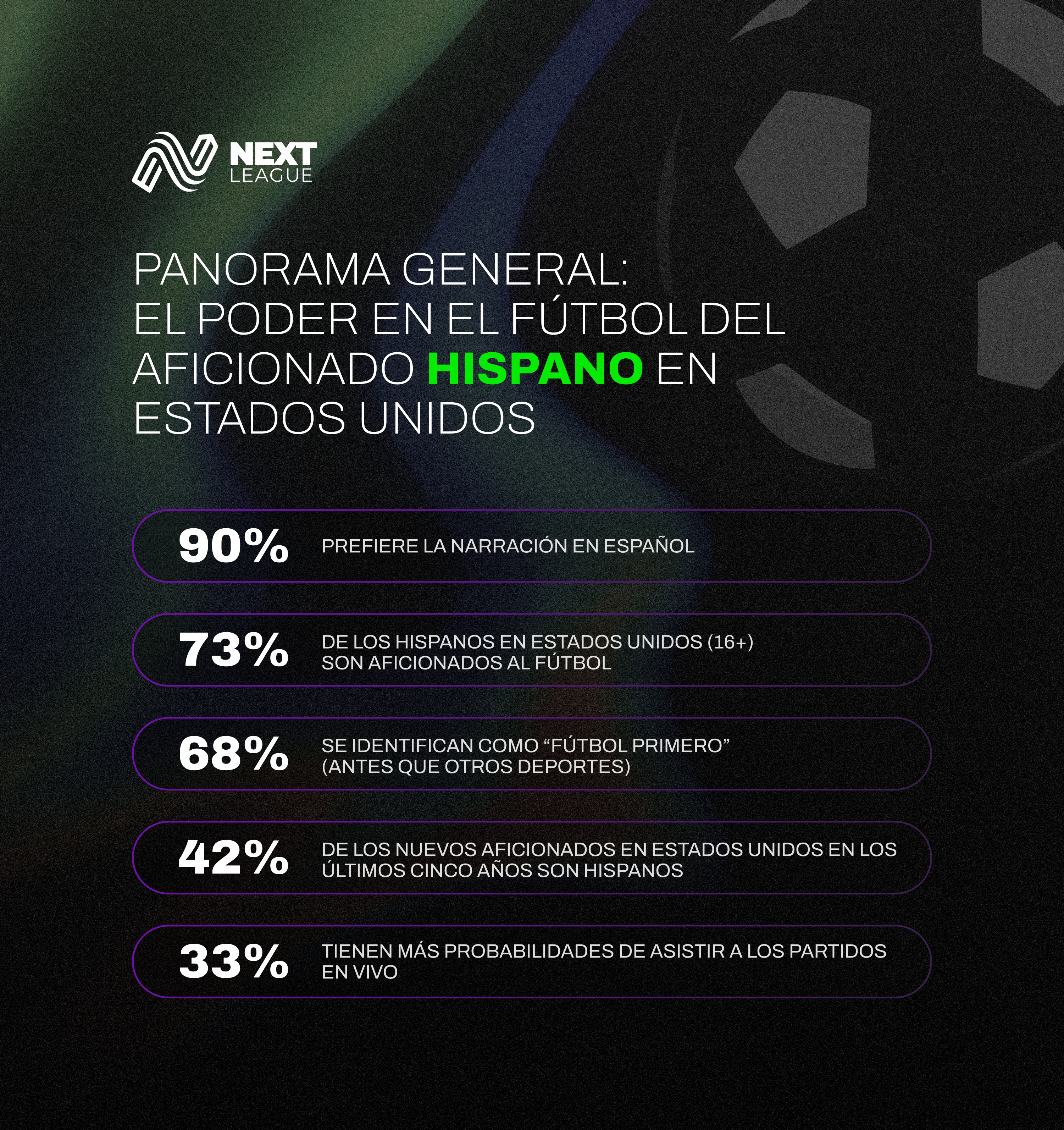
La industria global del fútbol está haciendo una apuesta audaz por el aficionado hispano en Estados Unidos y con buena razón. Con un un 73% 1 de los hispanos en Estados Unidos de 16 años o más que se identifican como fanáticos del fútbol, muchos describen este deporte no solo como un pasatiempo, sino como una parte de su herencia, algo con lo que crecieron y de lo que están increíblemente orgullosos.
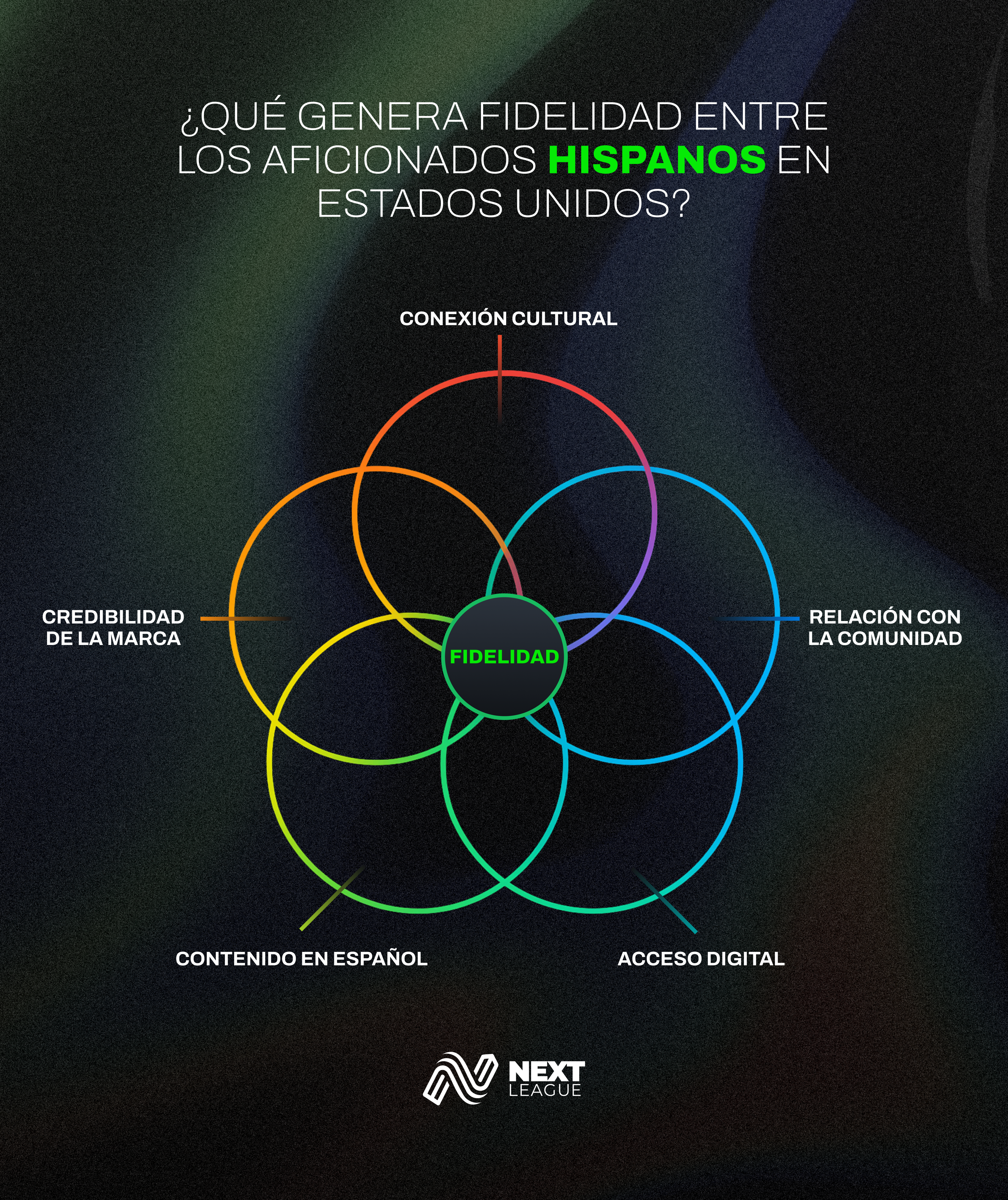
This deep-rooted passion is shaping everything from league strategies and stadium renovations to technology deployment and brand activations. According to For Soccer Research 2, el 71% de los aficionados hispanos en Estados Unidos dice que la representación cultural influye directamente en las ligas que apoyan, haciendo que el marketing bilingüe y las historias auténticas sean esenciales. A medida que el “Verano del Fútbol” 2025 avanza hacia julio, la verdadera pregunta es: ¿entendemos qué es lo que impulsa a esta audiencia, y estamos haciendo lo suficiente para estar a la altura del momento?
Cualquier organización que se esté preparando para la Copa Mundial de la FIFA 2026 y más allá debe tomar nota. Ignorar este cambio no solo es una oportunidad perdida, sino un error estratégico. Esta audiencia no solo está creciendo, sino que está redefiniendo cómo es la fanaticada moderna. Bilingües, con enfoque digital, expertos en tecnología, arraigados en la comunidad y leales a las marcas, los fans hispanos realmente están marcando el ritmo de cómo de ser el compromiso en el futuro.
APROVECHANDO LAS TECNOLOGÍAS EMERGENTES
Como organización participamos regularmente para ayudar a nuestros socios a aprovechar la inteligencia artificial y las tecnologías emergentes para comprender mejor a los aficionados, maximizar ingresos y mejorar las experiencias de los fans. El uso de estas herramientas y tecnologías ya no es opcional; son fundamentales para lograr un crecimiento comercial medible.
Para las marcas y los poseedores de derechos, la captura de datos en tiempo real y el análisis predictivo desbloquean conocimientos más profundos sobre el comportamiento de los aficionados hispanos: cómo asisten, ven comparten y compran. La personalización impulsada por la Inteligencia Artificial adapta los mensajes de manera que reflejan las particularidades culturales y la preferencia lingüísticas. Cuando se combina con estrategias modernas de lealtad (programas de recompensas, participación completa y acceso exclusivo), el impacto va más allá del alcance de la audiencia. Construye relaciones duraderas basadas en la confianza y la identidad compartida.
Ahora imagina esa infraestructura construida alrededor de la base de fans más emocionalmente comprometida y comercialmente desatendida en los deportes estadounidenses.
La urgencia no es especulativa, está respaldada por datos. Según TelevisaUnivision 3el 68% de los aficionados hispanos al deporte se identifican como aficionados al fútbol por encima de otro deporte. Esto indica más que una preferencia; representa una conexión cultural.
Esa pasión también se traduce en un impacto medible. Nielsen informó que los aficionados hispanos en Estados Unidos tienen un 33% más de probabilidades de asistir a eventos deportivos en vivo en comparación con la población general, lo que los convierte en una pieza clave para los ingresos en días de partido y las experiencias en el estadio. No son espectadores pasivos; son fanáticos profundamente comprometidos. Más importante aún, la curva de crecimiento muestra lo que está por venir: el 42% de los nuevos aficionados al fútbol en Estados Unidos en los últimos cinco años son hispanos. Esta audiencia no solo está sosteniendo el deporte, sino que está redefiniendo activamente cómo se transmite, se comercializa y se monetiza.
El idioma juega un papel fundamental. Las transmisiones en español continúan superando en rendimiento dentro de los hogares hispanos, y están ganando terreno también entre los espectadores no hispanos. Según TelevisaUnivisión (3), el 64% de los hispanos en Estados Unidos considera que el fútbol se ha vuelto más emocionante gracias a las mejoras tecnológicas y al crecimiento del streaming en español. Casi el 90% de los aficionados hispanos prefieren comentarios en español, y más del 65% de los fans no hispanos opinan lo mismo.
CONECTANDO LAS MARCAS CON LOS FANS HISPANOS
Más allá de la televisión tradicional, hoy existen más oportunidades que nunca para que las marcas se conecten con los aficionados hispanos. Según el informe de Nielsen y Latinos in Sports (4), el fútbol se ha convertido en un deporte con enfoque digital dentro de esta comunidad: el 69% transmite los partidos en vivo, el 49% ve resúmenes, y los fans hispanos tiene un 38% más de probabilidades de usar TikTok para contenido deportivo que la población en general. Estas no son tendencias emergentes, son expectativas actuales que ya están transformando la forma que se consume, comparte y comercializa el fútbol. 4 Soccer has become a digital-first sport within this community with 69% live streaming matches, 49% watching highlights, and Hispanic fans being 38% more likely to use TikTok for sports content than the general public. These are not emerging trends, they are current expectations that are already reshaping how soccer is consumed, shared, and commercialized.
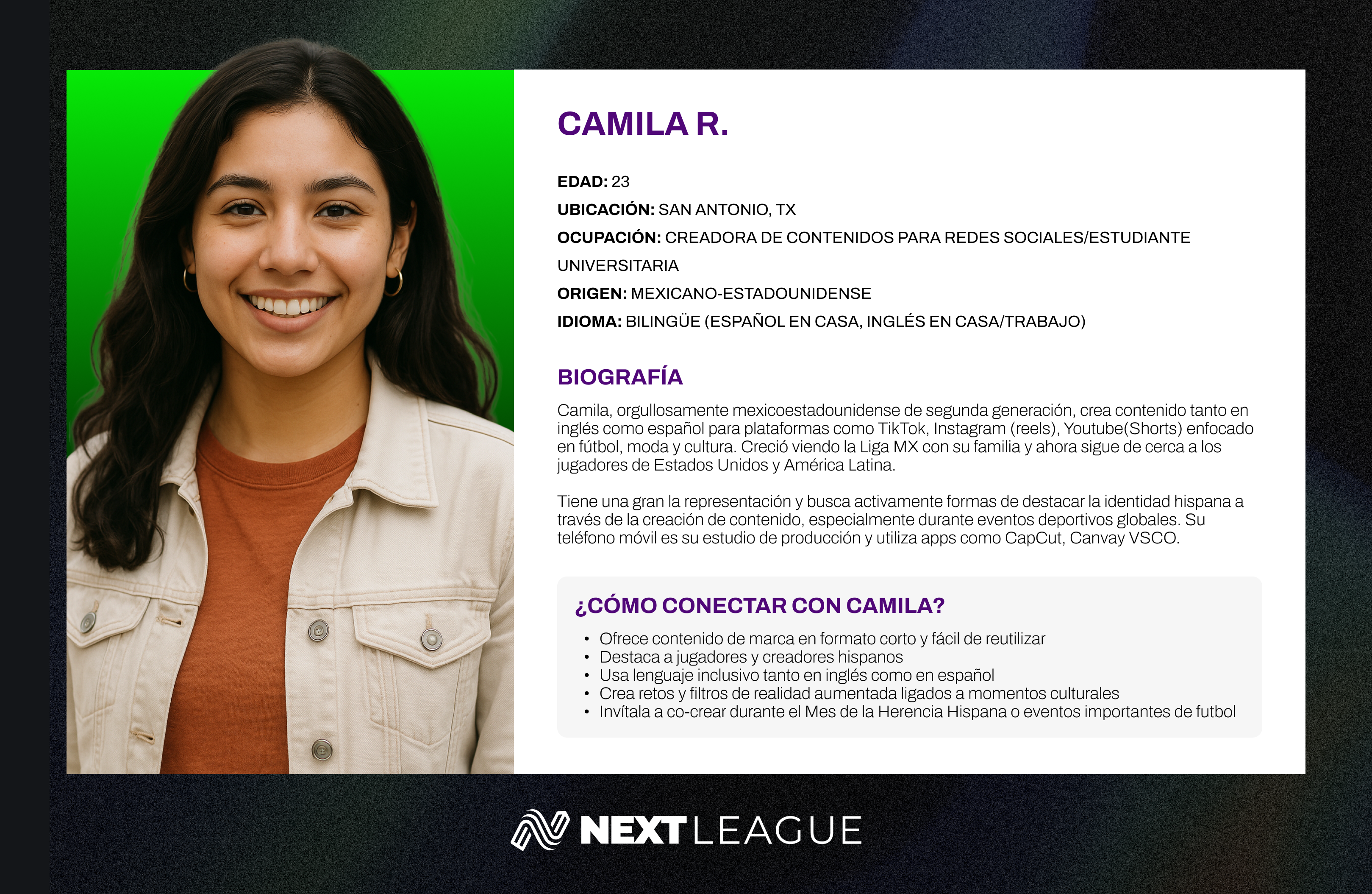
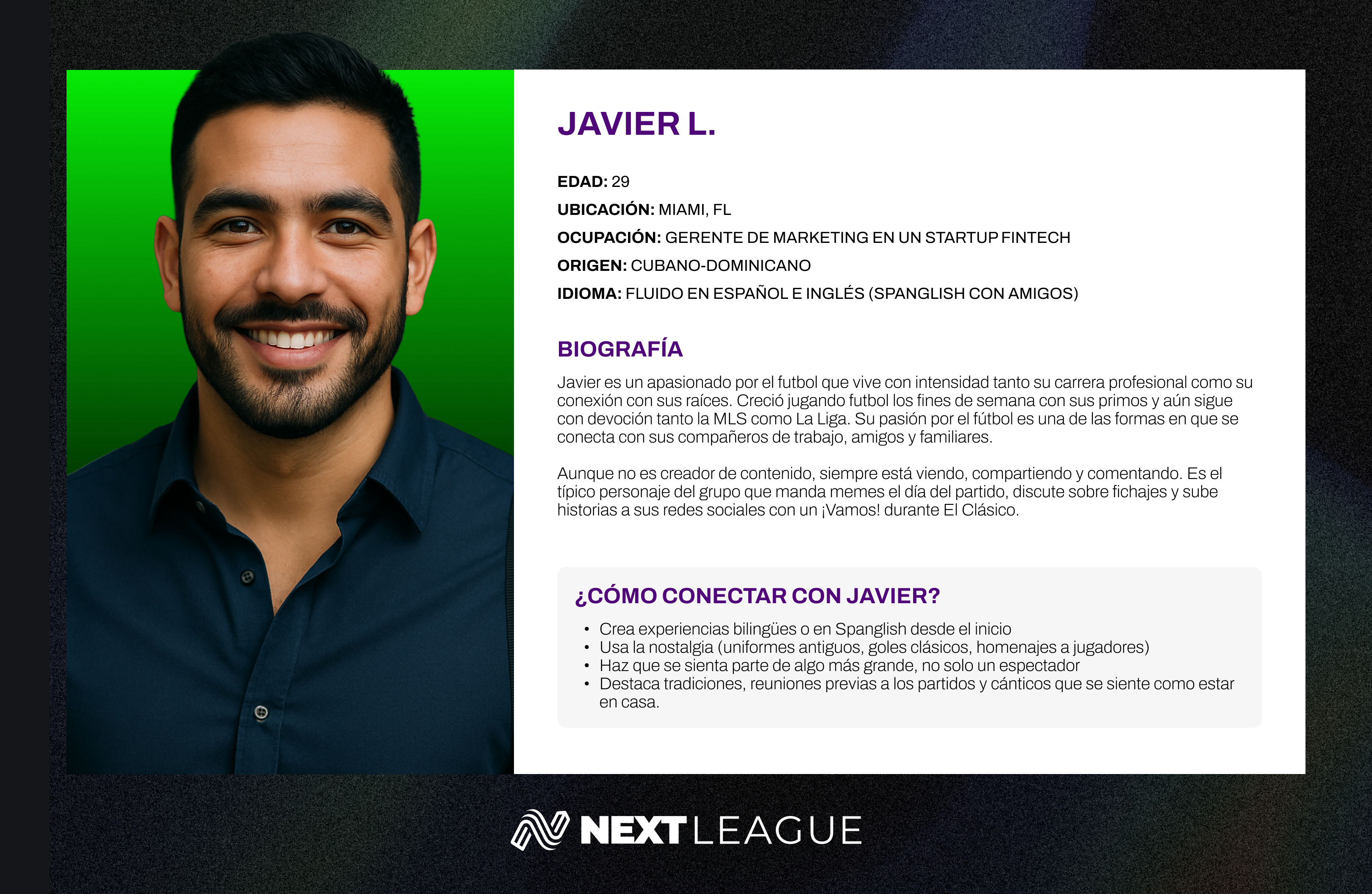
Para construir estrategias efectivas que conecten y capitalicen en el perfil actual del público hispano, es fundamental profundizar en quiénes son realmente los aficionados. En Next League dedicamos un tiempo considerable a desarrollar perfiles de usuario que ayudan a ilustrar las motivaciones, hábitos y matices culturales únicos que impulsan el compromiso de los fans. Al definir algunos perfiles clave, como el creador bilingüe de la Generación Z o el fan de legado con lazos generacionales profundos, podemos diseñar estrategias más relevantes, personalizadas y efectivas en todas las plataformas. Hacerlo con éxito puede y va a abrir nuevas oportunidades de ingresos para las marcas.
Los datos son claros. La audiencia está lista. El momento es ahora.
El mundo no solo apuesta por los hispanos en Estados Unidos para hacer crecer el fútbol; está confiando en ellos para definir su futuro. Con un calendario lleno de eventos de primer nivel y miles de millones de dólares en patrocinios en juego, el éxito dependerá de una decisión clave: si las ligas, marcas y medios están preparados para encontrarse con los fans hispanos donde ellos están: cultural, digital y auténticamente.
NOTAS AL PIE
Affina, a fusion of fan-engagement platform CrowdPlay and card-linked offer specialist Rethink Loyalty, has launched a “third way” in sports loyalty programs. Recognizing that many teams lack the in-house resources to develop and operate sophisticated loyalty systems, Affina delivers a fully managed solution. It combines gamified fan interaction (like trivia and QR-code rewards) with funding from external card-linked offers and provides hands-on program management. Since its December 2024 merger, the Boston‑based startup has doubled its client base annually, adding NBA, NHL, Fanatics, and soon an NFL club, and recently closed a seven‑figure Series A. Affina’s unique managed‑services model helps teams avoid past pitfalls, proving loyalty programs can now be sustainable and scalable
“People don’t quit jobs—they quit bad managers.”
It’s a phrase we’ve all heard, and for good reason: managers play a pivotal role in shaping the employee experience. They’re not just leading projects—they’re supporting the people doing the work. At their best, people managers foster engagement, satisfaction, and growth across their teams. At their worst, they’re often the reason talented individuals walk away.
At Next League we’ve always understood this truth, but Gallup’s State of the Global Workplace 2025 report makes it clearer than ever; manager engagement is no longer a nice-to-have—it’s a business imperative. When managers struggle, so do their teams. And when managers thrive, they create a ripple effect that lifts everyone around them.
The State of the Global Workplace 2025 report delivers a sobering message; global employee engagement has dropped to 21% from 23% last year. Even more concerning is that manager engagement is in sharp decline—from 30% to 27% globally—signaling a ripple effect that threatens team performance, retention, and business outcomes.
Why does this matter so much? Because managers account for 70% of the variance in team engagement. When our managers are supported, their teams thrive. When they’re not, disengagement spreads.
That’s why we invested early in our managers, launching Think Like a Coach in 2024. This year-long development program is rooted in the belief that great managers are great coaches—clear communicators, emotionally intelligent leaders, and trusted guides through complexity and change.
Our curriculum combines monthly sessions led by internal leaders and external experts, covering high-impact topics like emotional intelligence, difficult conversations, active listening, delegation, feedback, and situational leadership.
Our first cohort finished strong, and we’re gearing up to launch our second round this summer. This isn’t just a training series—it’s an important way we grow talent. It’s our way of saying that leadership isn’t about hierarchy but connection. And we’re setting up our managers to lead with clarity, care, and confidence.
The result? A stronger, more confident community of managers who feel supported and empowered—not just to lead but to grow.
Here’s what a few had to say:
“In a time of constant industry change and uncertainty, the manager training program has been a huge support. It empowered managers to navigate complexity with confidence and adapt with empathy. Thanks to this program, I feel better equipped to lead through diverse challenges with creative solutions—while keeping people at the center of every decision.”
“The management training program helped me slow down, listen more, and lead with more empathy, clarity and confidence.”
“The Think Like a Coach program sharpened my leadership instincts and gave me the confidence to lead more intentionally.”
“I’m really grateful for having this course, it definitely helped me to grow my theoretical knowledge, the practical exercises were great and fun, and it also showed me how others are dealing with similar problems, and how awesome our team is.”
At Next League, we don’t just architect and operate complex technologies for the largest sports brands in the world—we build community and culture for our people. Engagement is everyone’s responsibility and when we invest in our managers, we set the tone for an organization where people thrive.
Gallup estimates that global engagement would unlock $9.6 trillion in productivity worldwide if it rose to best-practice levels. That’s not just good culture - that’s good business.
We don’t just work in a people-first industry—we are a people-first organization. For our clients, for our teams, and for every individual who’s building the future of sports and technology with us.
We keep showing what’s possible when we put people first.
It's official. College athletes are about to get paid—and I’m not talking about NIL crumbs or free meal swipes at the training table. We’re talking direct revenue-sharing payments from schools. Real checks. Like, “Uncle Sam’s watching” checks.
The recent House v. NCAA settlement means schools could be shelling out around $20 million a year to their athletes. That’s right—college campuses are about to look a little less like institutions of higher learning and a little more like tax brackets. And while the headlines are all about justice, fairness, and finally giving athletes their due (amen to that)… let’s talk about the other wave this is about to create.
Growing up I looked at the NFL or NBA as the mountaintop. Now? College is the new professional league. Parents are going to start treating Pop Warner and AAU like private equity firms. We’ll soon be hearing things like “We invested early, we expect a return.”
Imagine how wild it's already been on the sidelines. Now throw $200,000 a year in potential earnings into the mix. Moms and dads aren’t yelling just for playing time anymore—they’re yelling over wages. “Why is my son only getting 12 snaps, Coach?! That’s future revenue sitting on the bench!”
Youth sports were already intense. This just took it from “competitive” to “Shark Tank meets Friday Night Lights.”
And here’s the thing that makes me pause: what does this do to the kids?
These young athletes are already under an immense amount of pressure. You’ve got 16-year-olds getting recruited on TikTok, ranked by strangers online, and now—potentially—valued like they're on the free-agent market. Don’t believe me? Just imagine an eighteen-year-old college kicker who misses a field goal and then spends the next 24 hours getting hate DMs because some fan lost a $30 parlay.
The NCAA even had to roll out a TV ad talking about harassment of athletes. And trust me, there’s going to be a lot more coming.
We’re selling dreams, sure. But pressure is part of the price tag. And for every athlete cashing in, there are thousands more wondering why they're not. We better be ready with more than just highlight reels and Hype House NIL collectives. These kids will need support—mental, emotional, and financial literacy – like never before.
Let’s talk about the new class system this creates. We're going to see a college environment where one athlete makes $2 million a year and the guy next to him gets $100,000. While this dynamic currently exists in pro sports, it will be new to college. In the NFL, there’s a clear class structure in the locker room. Players know who earns what, and why — it’s understood, accepted, and managed professionally. In college, that structure doesn’t exist. The transfer portal and NIL have introduced new variables and external voices — parents, agents, influencers — that impact player decisions in real time.
Without established hierarchies or standardized contracts, expectations can spiral and internal cohesion becomes harder to maintain. The result is a dynamic where players are constantly evaluating their value based on outside noise, not an established system. Only coaches know what this can do to a team that requires everyone's buy in on every play.
Then comes the real twist: What happens when college athletes making NFL-type money realize life after sports doesn’t come with direct deposit? It’s hard to go from $20,000 a month in college to $60,000 a year in corporate America. I saw this first-hand with a lot of guys who struggled to transition to life after their playing careers ended because the lifestyle was the first thing they built—and the last thing they could let go of.
This is déjà vu. Only now, we’ve moved the problem up a level.
I’m happy college athletes are finally getting paid. We earned it. But let’s not pretend this doesn’t come with new challenges. We’re shifting the entire sports economy—and youth sports is about to become a high-stakes audition tape. Parents will spend more. Kids will feel more pressure. Mental health will matter even more. And we’ll need to be ready to help athletes not just win now—but transition later.
As someone who’s lived through it, I can tell you: the hardest part of the game is what comes after it ends.
“How do we serve our current revenue-generating fans while also capturing the next generation?"
We frequently hear this type of question. Engaging fanbases with different behavioral patterns and psychographics certainly increases operational complexity. Understandably, many sports teams and leagues have focused on today’s revenue generating fans. However, your fan engagement strategy doesn’t have to be an “either/or” decision between engaging today’s core sports fans (Millennials and older) or the next generation (Gen Z and younger).
Teams and leagues can efficiently cater to multi-generational fan needs by applying data1-driven automated personalization alongside their integrated strategies and tactics. This type of approach is crucial to position your organization for sustainable growth as Gen Z emerges and becomes an increasingly critical consumer over the next decade.

Sports organizations, who haven’t been intentional about engaging Gen Zers, are at risk of missing out on this important emerging consumer. The youngest Gen Zers are reaching adulthood within the next decade. Further, U.S. Gen Zers already have an estimated annual spending power of $360 billion2. In comparison to other generations, Gen Zers’ expenditures are also projected to grow the most through 20353.
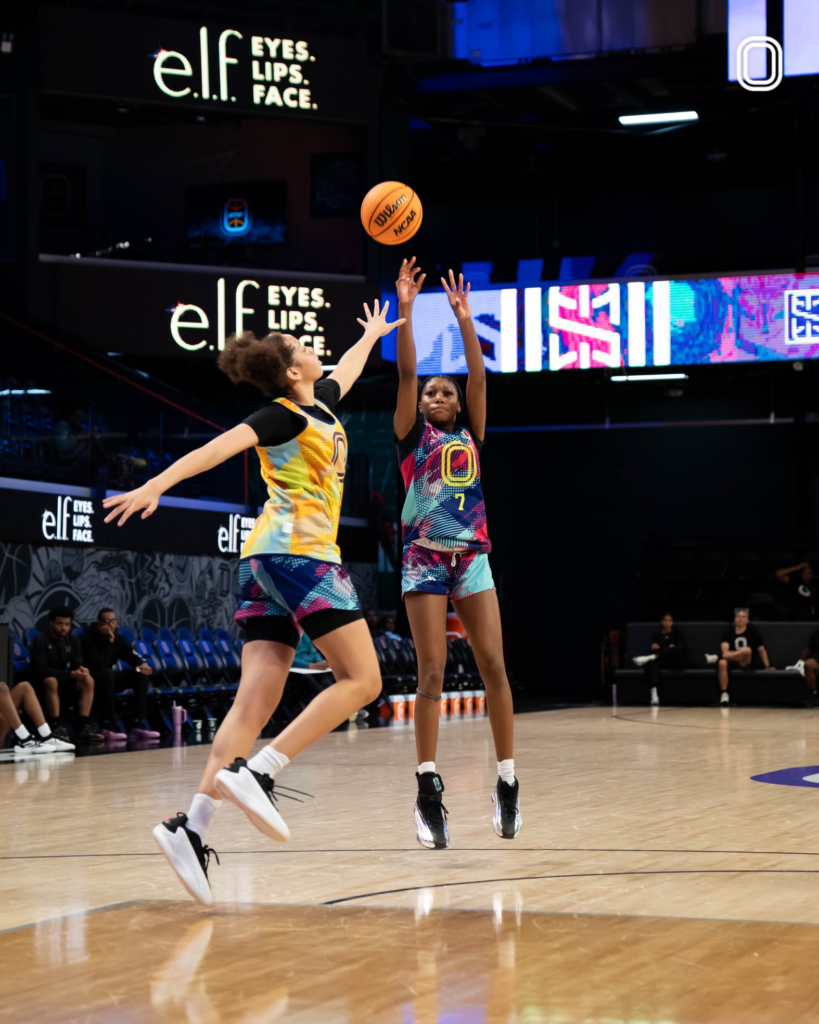
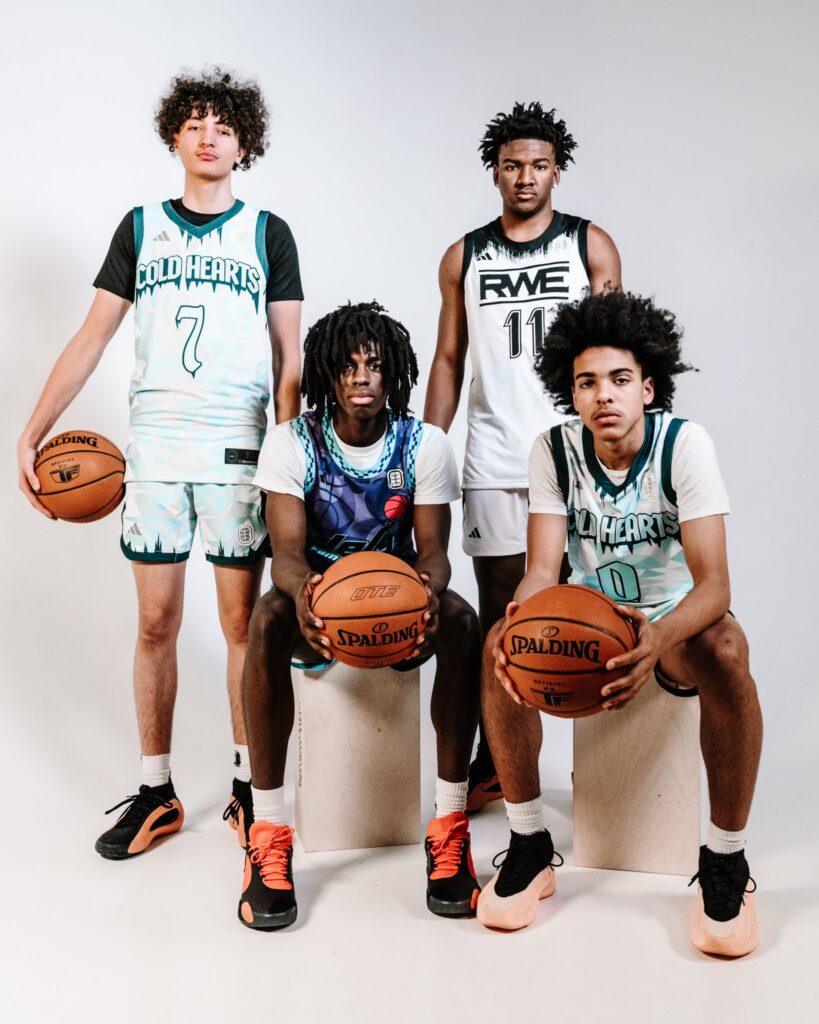
This emergence of Gen Z as a crucial consumer is directly impacting key sports revenue streams, from media and ticket sales to sponsorships and beyond. Gen Zers’ digital-first consumption habits have already contributed to the disruption of the media landscape. Their attraction to live sporting events is demonstrated by their willingness to attend games more consistently and pay higher ticket prices4. Additionally, as authenticity-driven, diverse, and socially conscious consumers, Gen Zers can be elusive to brands, so sports organizations that display meaningful engagement with this demographic are securing impactful sponsorship deals (e.g., Overtime’s range of partnerships from e.l.f Cosmetics to Adidas).
Three challenges that we often see when helping teams and leagues engage multiple generations:
Establishing the urgency of engaging Gen Z, securing internal alignment, and utilizing technology to scale your efforts are crucial steps to capturing the next generation of fans.
Among the ways we support clients’ needs to capture the next generation of fans is by helping them optimize their personalized fan engagement efforts. We often start this support by confirming the potential value of such an effort, as understanding the associated upside (and risk) helps leaders drive broad internal alignment. Once this alignment is established, we frequently conduct a personalized fan engagement readiness review. More context on these key steps outlined below:

Once we complete this type of review and support with the technology implementation, a client may, as an example, have the ability to send an exciting targeted player free agency update email combined with a season ticket upgrade offer to a dedicated Gen X fan, while simultaneously triggering a short-form vertical video and a single-game ticket offer to a new Gen Z fan. Beyond owned and operated digital touchpoints, on social media for example, where individual fan profiles are unavailable, high-level insights can be used to inform scalable tailored content and community management strategies.
The sports industry is already implementing a variety of strategies and tactics for reaching and engaging the next generation of fans - from integrating business models (e.g., League One Volleyball (LOVB)’s youth and professional structure) and fostering influencer/media collaborations (e.g., NBA Creator Cup and NWSL-Overtime), to leveraging modern media distribution (e.g., combination of streaming and legacy broadcast) and creating new or updating the in-game product (e.g., TGL and MLB)

These types of efforts, coupled with optimized technology and processes for personalized fan engagement, will be key to scaling the acquisition of Gen Z, a critical segment of fans for your organization's future success.
Are you ready to transform your fan engagement approach?
The above article is also available for PDF download here.
Acknowledgement
This research was led by Juan De Jesus in collaboration with Shripal Shah and Bora Nikolic. It was edited by Joanna Solowey.
Sources
Como una mujer que nació y creció en Brasil, mi pasión por el “Futebol” se remonta a mis recuerdos de infancia durante la Copa del Mundo de 1994. Luego de mudarme a Estados Unidos siendo una adolescente he sido testigo del notable ascenso del fútbol en este país y del papel cultural transformador que ha desempeñado desde entonces.
El futebol siempre ha estado en mi ADN. La pasión por la Canarinha, como se le conoce popularmente a la camiseta amarilla y verde con las cinco estrellas de campeón, es algo que siempre atesoraré. Reflexionar sobre el impacto de la Copa del Mundo de 1994 me lleva más allá del penalti final con el que Brasil venció a su similar de Italia. Como joven aficionada, viví el juego a través del lente del orgullo nacional: el puro fanatismo, las celebraciones con pintura en la cara y los juegos artificiales (todo esto mientras los adultos seguramente disfrutaban de sus caipirinhas).
Durante las últimas tres décadas, el crecimiento del fútbol en Estados Unidos ha sido un fenómeno digno de observar. Las dos Copas del Mundo celebradas en Estados Unidos durante los últimos 90 años tuvieron un impacto profundo en el crecimiento y en la popularidad del deporte en el país. Desde la Copa del Mundo de la FIFA de 1994 hasta el auge de la MLS (Major League Soccer por sus siglas en inglés) y el crecimiento explosivo de la NWSL (National Women’s Soccer League), “el juego bonito” ha pasado de ser un deporte de nicho a una parte prominente de la cultura deportiva estadounidense.
Hoy, con menos de 450 días para el inicio de la Copa del Mundo de la FIFA de 2026, el comienzo de la temporada No. 30 de la MLS y el arranque de una nueva temporada de la NWSL, el escenario está listo para que el fútbol alcance alturas sin precedentes en Estados Unidos.
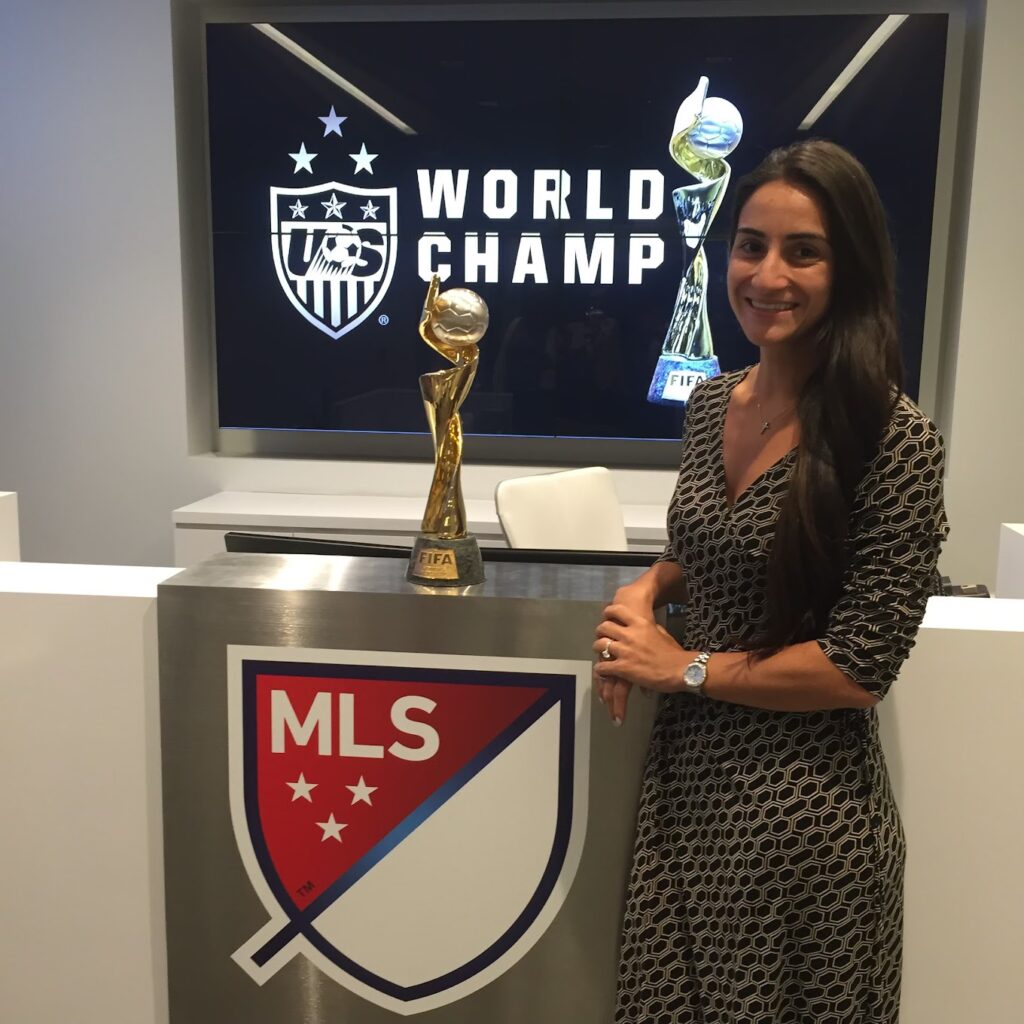
La Copa del Mundo de 1994 despertó el interés al mostrar su atractivo global y atraer a diferentes tipos de público. En ese momento, Estados Unidos experimentaba un cambio demográfico con una población latina en ascenso, la cual hoy representa el 19.1% de la población del país.1Este cambio impulsó la participación del país en el fútbol ya que muchos latinos trajeron con ellos su pasión por el deporte, creando así, una base sólida de jugadores y aficionados. Además, el fenómeno de las “soccer moms” (mamás futboleras), que vio un auge en la participación juvenil impulsado por familias de clase media, especialmente en zonas suburbanas, se transformó en un rasgo definitorio del desarrollo del deporte.
El crecimiento sustancial en la participación de los jóvenes en el fútbol ha continuado, con más de 14 millones de personas jugando al aire libre en Estados Unidos en 2023, lo que representa un aumento del 8%2 respecto al año anterior. Lo anterior ilustra la notable expansión en el país. Después de 1999, gracias al éxito del fútbol femenino y a una población más involucrada, la participación se disparó, reflejando la creciente integración del fútbol en el panorama deportivo estadounidense.
Si bien las Copas del Mundo anteriores ayudaron a despertar el interés y la participación en el fútbol en Estados Unidos, creo que la Copa del Mundo de 2026 finalmente establecerá al país como una potencia futbolística a nivel internacional. Los aficionados lo sentirán, los jugadores lo experimentarán y las inversiones seguirán llegando.
Los fanáticos del fútbol de todo el mundo verán, escucharán y sentirán esta pasión. La FIFA proyecta que las 16 ciudades sede recibirán a más de cinco millones de aficionados durante el torneo que se prolongará por un mes.3Para quienes tenga la suerte de asistir a un partido en persona, vivirán una experiencia única en algunos de los estadios más increíbles en ciudades como Atlanta, Kansas City, Dallas y Los Ángeles. Se organizarán fiestas y eventos en todo el continente, rivalizando con personas de diferentes países. La energía y el entusiasmo serán palpables de costa a costa.
Los propios atletas entrenarán en instalaciones específicas de fútbol, algunas nuevas o recientemente renovadas como las de KC Current y Atlanta United. Los mejores futbolistas del mundo conocerán estas instalaciones de primer nivel, las cuales incluyen campos de entrenamiento, gimnasios perfectamente acondicionados, centros de tratamiento y aulas para análisis. Las instalaciones de los equipos en Estados Unidos son, en promedio, muy superiores a las del extranjero. Será una oportunidad increíble para que los jugadores internacionales experimenten las comodidades y los servicios que los equipos estadounidenses ya disfrutan.
Las inversiones en el deporte continuarán. La globalización del fútbol también ha acercado a las personas, fomentando conexiones interculturales y experiencias compartidas. A medida que el deporte sigue creciendo ha demostrado ser un medio para unir comunidades en todo el mundo y reforzar su atractivo global. La gente anhela conexiones y experiencias en conjunto, por eso, se espera que fluya más dinero hacia el deporte para satisfacer esta demanda.
El fútbol ha transformado el panorama deportivo al convertirse en una fuerza global que conecta diferentes culturas. Su creciente popularidad, especial en América del Norte, ha reformulado la forma en que los aficionados se involucra, cómo se cubre en los medios de comunicación y el funcionamiento de toda la industria deportiva. Con la Copa del Mundo de la FIFA en 2026, los Juegos Olímpicos de Los Ángeles 2028 y el reciente anuncio de la Copa del Mundo Femenina de la FIFA 2031 (en Norteamérica), el fútbol está preparado para un crecimiento mucho más grande. El Mundial del próximo año organizado por Estados Unidos, México y Canadá elevará el perfil del deporte, mientras que los Juegos Olímpicos aumentarán aún más su visibilidad, especialmente con el auge del fútbol femenino.
Como aficionada del futebol de toda la vida, tanto en lo personal como en lo profesional, estoy emocionada de presenciar y ser parte del crecimiento global del fútbol y del papel que desempeña para unir comunidades y seguir avanzando.
NOTAS AL PIE
Written by Brian Jones
College Football Analyst, CBS Sports
College Sports, Next League
We’re entering a new era where athletes don’t just play the game, they tell the story. And the industry is only beginning to catch up.
I just returned from my first trip to the annual NAB Show (and its Sports Summit more specifically) in Las Vegas — one of the largest gatherings of industry executives working behind the scenes in sports, media, and entertainment. While a lot of the technology was over my head from an engineering standpoint, I saw something that matters to everyone in sports: the entire system of content creation, delivery, and fan interaction is changing — fast.
This shift isn’t just about camera angles or better graphics packages. It’s about how stories get made, who tells them, and how fans interact with what they’re watching. That matters more than ever — not just for the networks, but for schools, teams, brands, and athletes themselves.
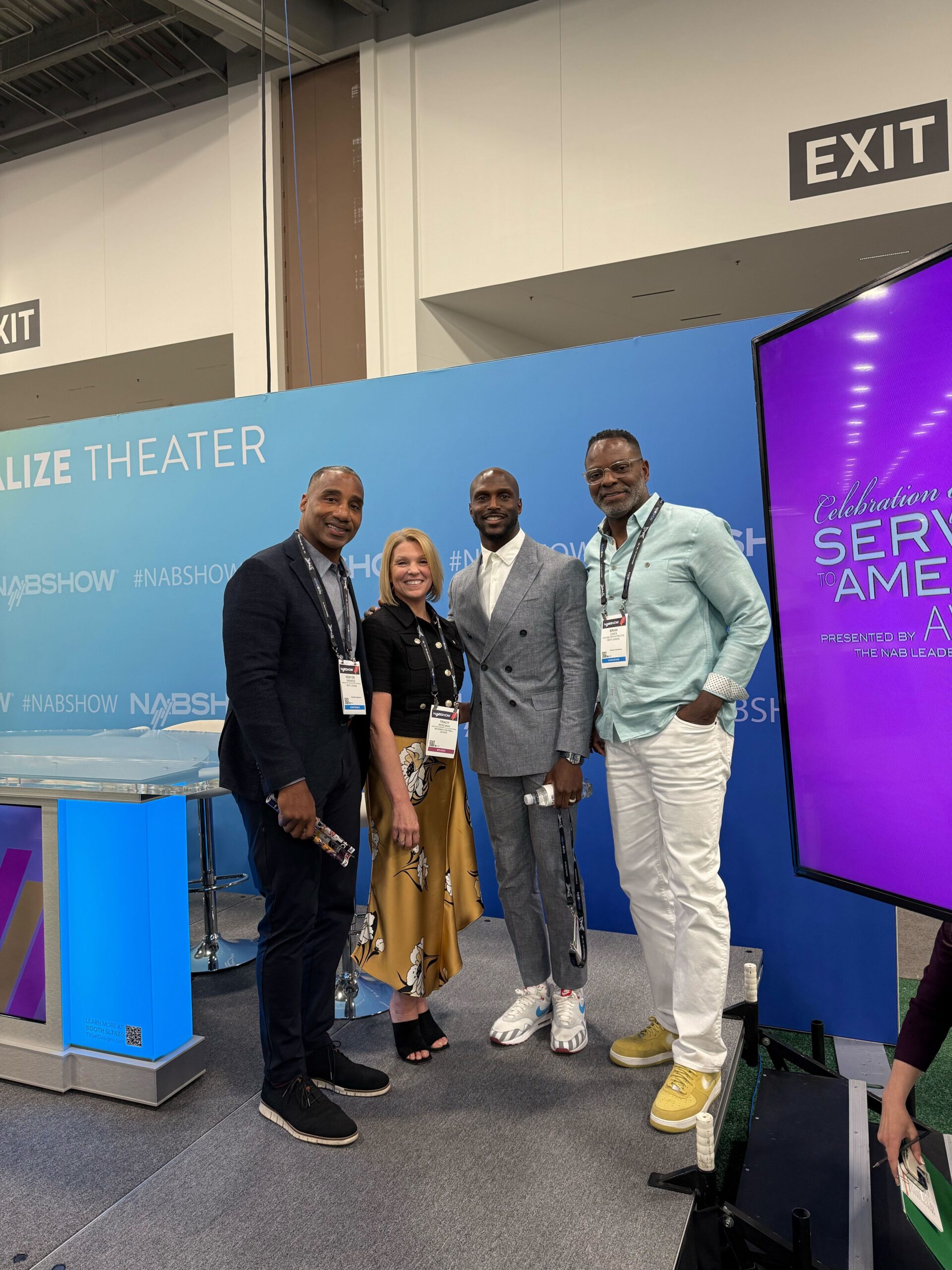
What stood out most to me was the growing focus on enabling creativity at a very basic level. Professional-grade tools — like the kind Adobe is building and highlighting in their Creator Labs — are starting to show up directly inside athletic departments. At the same time, schools are investing in on-campus production studios that give athletes and creative teams the power to produce high-quality content in real time. That’s not just about slick highlight reels. It’s about recruiting, fan engagement, brand-building, and in a lot of cases, helping athletes create real commercial value in the NIL era.
But access alone isn’t enough. At Next League we understand how important it is to build systems supported by process — not just drop in tools. If you don’t have a plan for content workflows, data capture, monetization, or sponsor integration, you’re just adding more complexity. The organizations that win in this space will be the ones that connect the dots across departments — and turn creative opportunity into long-term value.
One area I see gaining traction is how schools and teams are extending the live game experience digitally. Think second-screen experiences built for universities — school-branded watch parties, live chats, and digital spaces that bring fans together while the action unfolds. These aren’t just nice-to-haves. They’re fast becoming strategic tools for engagement, data capture, and sponsor activation.
These aren’t massive tech lifts. In many cases, they’re simple products that help drive engagement, grow databases and activate sponsor value. And when done right, they open the door to new revenue and deeper fan connection — without requiring a full production overhaul.
What I saw at NAB — and what we’re building toward every day at Next League — is a clear shift: from traditional, top-down production to a model where athletes, schools, and creative teams are driving the storytelling.
This hits home for me in three distinct ways:
The future of sports media and the evolution of sports storytelling won’t be built on any one platform or product. It’ll be shaped by a strategy that leverages technology, but is not held hostage by it. Sports organizations with a clear strategy, measurable KPIs and technology investments that are focused on outcomes will lead the way in 2025 and beyond. The right use of technology allows you to move faster, tell better stories, and engage more people in meaningful ways.
This shift is already happening. I can tell you this: organizations that are experimenting today are the ones who will be leading the industry tomorrow.
En Next League, hablamos frecuentemente sobre crear soluciones digitales para lo que viene en el deporte. Pero la pregunta que toda persona de marketing, liga o equipo debería hacerse es: ¿quién sabe qué viene antes que nadie? La respuesta está justo frente a nosotros: los propios atletas.
Durante mucho tiempo, la industria ha tratado a los atletas como activos temporales: acuerdos de patrocinio, firmas de autógrafos o momentos virales en redes sociales y competencias deportivas que suben y bajan. Pero la verdad es que los atletas son el activo número uno para cualquier negocio deportivo, y eso nunca cambiará.
Los atletas están en el centro de la inversión, la innovación y la energía que impulsan a la industria del deporte hacia adelante. Se han construido ecosistemas enteros basados en nuestra capacidad para atraer, influenciar y conectar con los aficionados y el público en general. Si bien el concepto de Nombre, Imagen y Semejanza (NIL, por sus siglas en inglés) tiene una vida útil, como ex-atleta profesional, puedo asegurar que el concepto de inteligencia del atleta no la tiene.
A lo largo de los años en el campo, dentro de los vestuarios, en oficinas principales y salas de juntas, los atletas acumulan conocimientos a un nivel que pocos ejecutivos del negocio deportivo alcanzarán. Es el tipo de visión que solo se gana viviéndola: aprendiendo el negocio desde sus cimientos y viendo cómo realmente funciona desde adentro hacia afuera. Y con base en lo que he experimentado de primera mano, los atletas que prestan atención a esto mientras juegan —los que mantienen la curiosidad sobre el negocio que los rodea— suelen ser los que más éxito tienen después de su carrera deportiva. Esa inteligencia es permanente, poderosa y en gran parte desaprovechada.
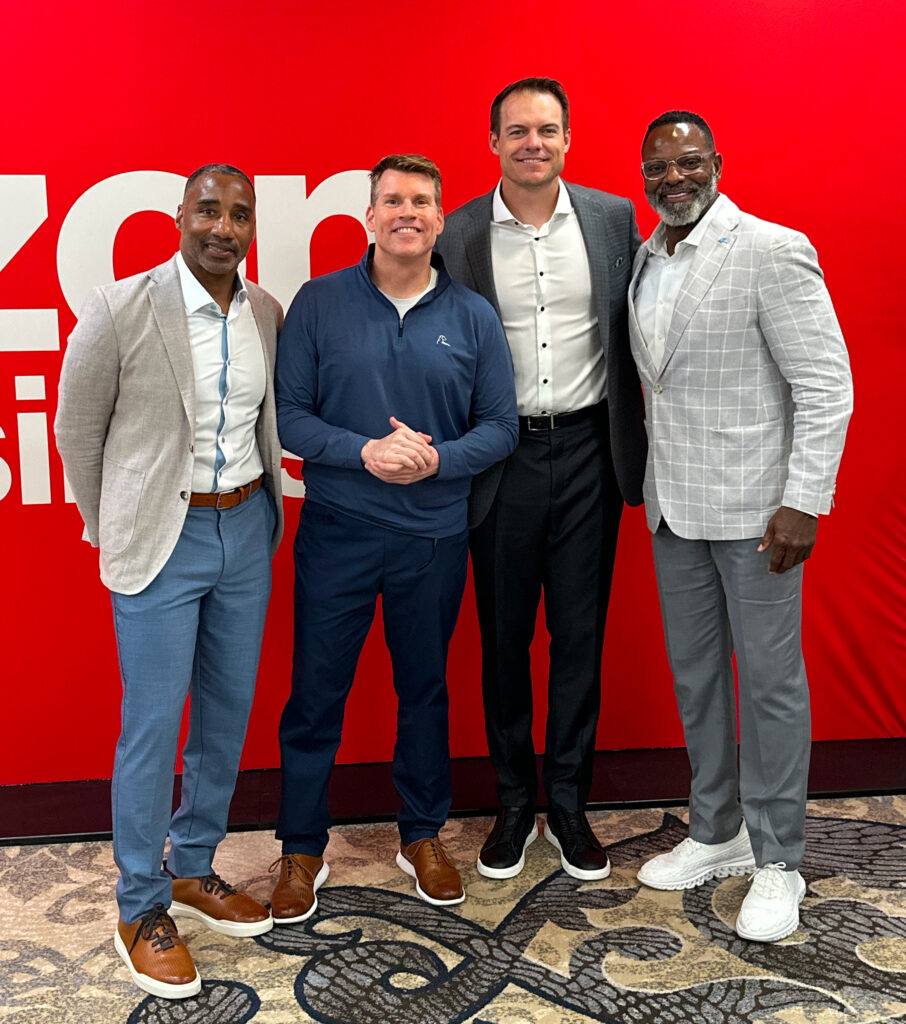
A lo largo de mi carrera, he visto marcas y empresas tecnológicas desarrollar productos, servicios y campañas para atletas sin siquiera sentarse a escucharnos primero. Rara vez nos preguntan cómo pensamos sobre el compromiso con los fans o qué herramientas y tecnologías podrían ayudarnos a rendir mejor, recuperarnos más rápido o generar un impacto duradero. Muchas veces se nos invita a invertir, respaldar o entretener, pero no a asesorar, diseñar o liderar. Esa desconexión no solo es frustrante, es una oportunidad perdida.
Y esas oportunidades perdidas han llevado a algunas de las experiencias más significativas de mi carrera.
Hace años, empecé a notar cómo se manejaba la información médica de los atletas. Esa información personal se compartía entre equipos, entrenadores y personal de una manera que no sería aceptable para ningún otro paciente. Al notar esta desconexión, decidí aprender verdaderamente sobre las normas HIPAA y cómo, a menudo, se pasaban por alto o se ignoraban en el deporte profesional.
Esa experiencia me ayudó a ver la necesidad de un sistema mejor: uno que respetara la privacidad del atleta, diera transparencia al intercambio de datos y cumpliera con los estándares médicos. A partir de esa visión, ayudé a construir el primer sistema de registros médicos electrónicos compatible con HIPAA en el deporte profesional. No esperamos que la industria se adaptara, creamos el nuevo estándar. Eso es lo que significa la inteligencia del atleta en acción.
Ese mismo enfoque nos guio cuando construimos Edge3. Enseñar a un modelo de IA lo que es más importante para jugadores y entrenadores no comienza en una sala de juntas. Comienza en el campo de entrenamiento, en la sala de video, y en la mente de atletas y entrenadores que llevan años perfeccionando su oficio. No pedimos a los atletas que prestaran su nombre al producto. Les pedimos que lo enseñaran, que compartieran esa inteligencia que solo nace de la experiencia. Ese conocimiento se integró en el sistema mismo — prueba de que la inteligencia del atleta no es abstracta.
Aplicamos el mismo enfoque trabajando junto a Verizon para desarrollar una nueva tecnología de IA para las bandas laterales en equipos universitarios y profesionales. Esa tecnología no surgió de un roadmap de producto. Surgió de conversaciones con atletas y entrenadores que sabían lo que necesitaban para adaptarse en tiempo real: cómo debía fluir la información, qué distracciones evitar y cómo se ve la claridad cuando hay que tomar decisiones en segundos. Verizon comprendió que la innovación real empieza cuando dejas de construir alrededor de los atletas y empiezas a construir con ellos.
Esto no se trata solo del pasado, sino de lo que viene. Next.
Hoy en día, ligas y cadenas de televisión están monetizando los datos de los atletas, desde métricas biométricas hasta estadísticas de rendimiento, sin involucrar a los propios atletas. Basta con ver una transmisión del NFL Combine para observar cómo se mide a los prospectos actuales en comparación con marcas históricas. Esos puntos de referencia son propiedad intelectual, y sin embargo los atletas en los que se basan no son compensados.
En los mercados de apuestas, los datos de rastreo en tiempo real aumentan el engagement y los ingresos, pero los jugadores no tienen voz en la mesa. Pero creemos que eso cambiará muy pronto. El futuro de los datos de los atletas se basa en licencias, propiedad y monetización a largo plazo. Las conversaciones que estamos teniendo ahora con marcas y ligas son sobre cómo liderar ese cambio, no reaccionar ante él.
Los equipos también tienen un papel en transformar esta dinámica. Creemos que si realmente quieren entender qué les importa a sus fans, deberían empezar por escuchar a sus atletas. Los atletas interactúan con los fans todos los días — en el campo, en la comunidad y en redes sociales. Recibimos comentarios directamente y sabemos que nuestra autenticidad es lo que impulsa la conexión y la lealtad. Conocemos los ritmos de la temporada, los momentos en que la conexión importa más, y las dinámicas no dichas entre equipo y afición. Esa es inteligencia que ningún CRM puede replicar.
En Next League, transformamos esa inteligencia en acción. Ayudamos a las organizaciones deportivas a tener éxito mediante soluciones personalizadas que generan resultados. Nuestra misión es entregar lo que viene: plataformas, herramientas y ecosistemas co-creados con atletas, basados en su experiencia y diseñados para generar valor a largo plazo para marcas, equipos y ligas.
Las empresas que liderarán la próxima década de innovación deportiva no serán las que extraen datos de los atletas para convertirlos en dashboards. Serán las que se sienten cara a cara y pregunten: “¿Qué sabes tú que nosotros no?” Ya lo hemos demostrado. Ya lo hemos construido. Y ahora lo estamos escalando.
La pregunta ya no es si este cambio está ocurriendo, sino: ¿en quién confías para guiarte a través de él?

JUSTINE CHIU
Growing up, I didn't participate in team sports. Most of my physical activity was through Dance Dance Revolution at the mall arcade by myself, and the closest I got to an actual sport was figure skating up until the age 12, which also happened to be a highly solo sport.
It was not only when I met my partner that I entered the world of curling. It is a sport where you will meet and play with people of all ages, physical strengths, and personalities. It taught me a lot about communication on and off the ice, and introduced me to multi-generational friendships. Curling showed me that it's never too late to get your start in sports.

BECKI CIVELLO
I fell in love with playing sports at a young age and learned many invaluable life lessons along the way - teamwork and perseverance - among others. I had the privilege of having an incredible youth soccer coach - he had the team start and end every game with a three H’s chant - “Heart, Hustle, Have Fun” - regardless of the game outcome. It was incredibly impactful. The “three H’s” stayed with me and I try to live by them every day.

NICOLE DABE
“I am a member of the team, and I rely on the team, I defer to it and sacrifice for it, because the team, not the individual, is the ultimate champion” - Mia Hamm

VERONICA DAY
Track & Field was my first passion, shaping my journey from childhood through college and beyond. It became the foundation for my success in more aspects of life than I ever imagined—from navigating professional challenges to competing for Team USA in skeleton. It instilled discipline, confidence, teamwork, and the bravery to push past limits. Encouraging more girls to compete in sports means giving them the same opportunity to build lifelong skills that extend far beyond the field of play.

ALLIE FUMO
Playing volleyball taught me about teamwork, perseverance, and leadership—skills that have been crucial in every aspect of my life.

BRITTANY MARCHAND
Sports have been a part of my life from the very beginning. Golf in particular, brought me more than I could have ever imagined. The travel, the friends, the connections, the wins and the losses…I am grateful for it all.
But one of the things that I am most grateful for, was the discipline and determination it taught me.
My grandfather got me into golf and he instilled in me that with hard work and discipline anything was possible. And he was right, there was nothing like the feeling of holding up a trophy knowing that all your hardwork and determination had just paid off.
Though I’m not playing competitively anymore, I still use all that I learned from sport in this new chapter of my life.
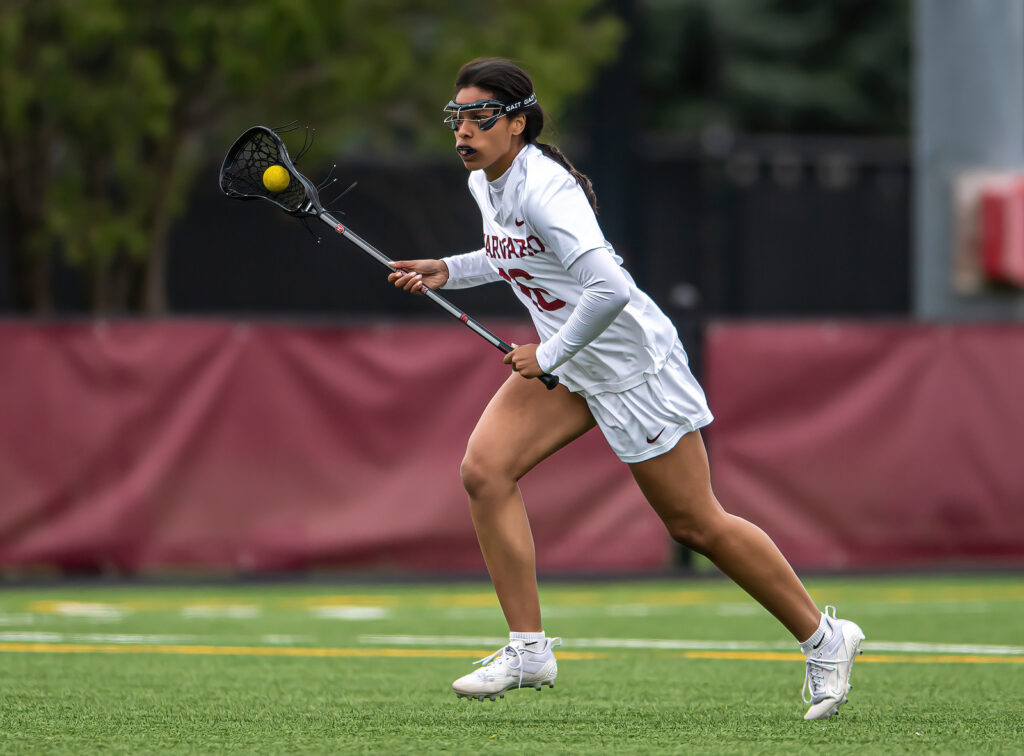
OLIVIA PROCTOR
Growing up, sports gave me the chance to travel across the country and build friendships with people I never would have crossed paths with otherwise—an experience that has been one of the highlights of my life. Lacrosse, in particular, opened doors for me to receive an incredible education, setting me up for success both professionally and in life.

JOANNA SOLOWEY
Sports have been part of my life for as long as I can remember. My father instilled in me a love of baseball - and the Yankees, in particular (hence the #7 on my jersey) - from a very young age. In fact, my parents still joke that I learned to read by reading the box scores in The New York Times every morning.
I am incredibly hopeful my two young children will love sports as much as I do. Playing a team sport taught me so many critical life lessons - about myself, how to work with and depend on others, how to win and lose graciously - and I can’t wait for them to have those experiences too.
At a minimum, I am grateful my daughter has the opportunity to play softball from a young age (and not with the boys like I had to) and that, should she play, her batting helmet will come with a hole in the back for her ponytail!

CRISTINA VANDERBECK
I swam competitively till I came to the U.S. - I was part of the (Brazilian) state and even national team between 11-15 years old - funny enough one of my first trips to the states was for a swim camp in Fort Lauderdale when I was 12.
 Spanish (LatAm)
  English
  Portuguese